Wednesday, August 7, 2013

Peggy's Cove

The first time you lay eyes on Peggy's Cove its pretty amazing or at least I was amazed. For one, the amount of rock in the area and two how peaceful it was even with lots of people around. Peggy's Cove is on the eastern shore of Nova Scotia approximately 46 kilometers from Halifax. There are many theories as to how Peggy's Cove got its name which I won't get into but it is most famous for the lighthouse built in 1868.
Peggy's Cove Lighthouse
Peggy's Cove was formed in 1811 with settlers relying on fishing and farming. Have you seen the rock. I'm not sure where the cattle would graze. However, today it remains an active fishing village and favorite tourist hotspot.
Fishing sheds and boat
The area has been designated a preservation site thereby no development is allowed in and around Peggy's Cove. The lack of soil and the effects of high winds and salt cause stunting of the few trees there are.
Very few trees and lots of rock
Painter and sculptor William deGarthe whom lived in Peggy's Cove sculpted a granite outcropping 30 meters in length. This sculptor depicts 32 fisherman, their wives and children being protected by St Elmo, the patron saint of sailors.
Sculptor by William deGarthe
Just down the road and a short distance from Peggy's Cove is one of two memorial sites for Swissair 111 that crashed on September 2, 1998 killing all 229 people on board.
The memorial to the right and Peggy's Cove in the background
Continuing down the road you come to a nice fishing village called Hacketts Cove.
Hacketts Cove
In Hacketts Cove there's a small roadside restaurant and market that sells fresh cooked lobster, scallops, and mussels. We forgot a cooler or we would have been hauling some home.

Sunday, August 4, 2013

Truro, NS


The town of Truro, known as the hub of Nova Scotia seemed to be the best place to plunk ourselves for a week or so. To us it was central to most things we wanted to see. The campground we chose was Scotia Pine Campground. It had everything we wanted, W/E(50amp)/S plus free WiFi, pool for those hot days, and cable so we can watch the finale of the Bachelorette. Yes we watch the show.
Registration Office
Beautiful tall pine trees lots of shade zero privacy
This campground had tons of large trees. Each site was a pull-thru you just had to know where your connections were. The sites were narrow but defiantly doable.
Our site # 70
For more than 100 years Truro was adorned with large elm trees. However, Dutch elm disease arrived in 1982 destroying many. The launch of the Truro Tree Sculpture Project was to make the most of an unfortunate situation. From the dead elm came life in the form of sculptures. Twenty-seven trees were sculpted some on site others created elsewhere and placed in fitting locations.
Hiram Hyde (1817 – 1907)
Hiram Hyde established a mail and passenger stagecoach service between Halifax and Pictou via Truro.
Lumber Jack circa 1900

The lumber jack represents the existing major role that Truro has played in the development of forestry in Nova Scotia.

Robert Lorne Stanfield (1914 – 2003)
Born in Truro, Stanfield served both Nova Scotians and all Canadians during his political career.
 
As we walked and drove around Truro several sculptures still exist. Some have come and gone mainly due to decay and vandalism.
It was by accident that we came upon Victoria Park in the center of Truro. What a beautiful place to picnic, walk, and have fun. Victoria Park came into being in 1887 when 27 acres of land was donated to the city. Since then further gifts and purchases have culminated in a 358 acre park. The nice thing about this park is much of its natural state of beauty has remained undisturbed.
Yes, that's Susan way down there
Plenty of stairs for an aerobic workout
We were rewarded with a gorgeous waterfalls
Want to see a river change directions before your very eyes. Well that is one of the reason we are in Truro. I’m talking about the famous Bay of Fundy Tidal Bore. Twice in a 24 hour period the tide will rise and fall in the Bay of Fundy. During each 12 hour tidal period 115 billion tons of water will flow in and out of the bay. When tide water enters the bay it continues toward the head of the bay constantly being squeezed by the narrowing rivers. As the river becomes shallower and narrower the incoming tide forms a wave the size of a ripple or one several feet high.
Tide still going out
Just before the Tidal Bore note the barrel on the right
Small Tidal Bore but still amazing
No more barrel, took 10 minutes to cover, the tide was still flowing in
The highest water level ever recorded in the Bay of Fundy occurred in October 1869 during tropical cyclone “Saxby Gale”. The water level rose 21.6 meters (70.9 feet).


Wednesday, July 31, 2013

North Cape, PEI


During the organization part of this trip we decided to spend a week at the other end of PEI also known as the western end. The first town we explored was O’Leary which is home of the Canadian Potato Museum. Of course it is where else would it be we are in PEI.
Potato Museum
Beautiful wall murals adorn the side of the building depicting potato farming.
 
Rarely today you pay $2 for a 10 lbs. bag of potatoes. Here in PEI new potatoes cost $5 for 5lbs.

As we walked around this little town we found numerous buildings that had somewhat of a historical meaning for this place.
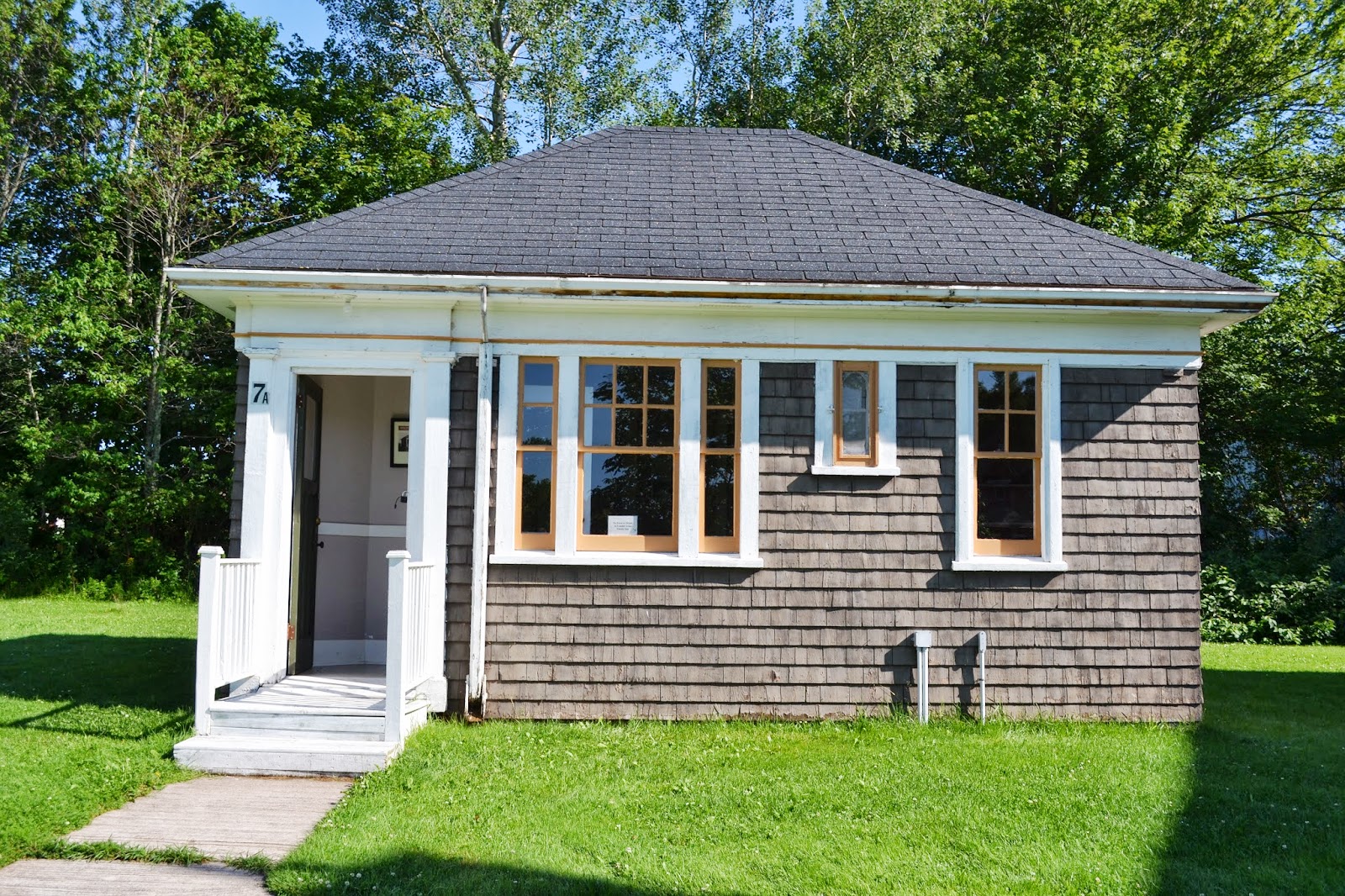
Old Schoolhouse
This little one room schoolhouse was built around 1900 and continued in use until 1972. It housed students from grade one to ten.
I remember my first desk was just like this
I remember spending time in the corner
In 1928 the O’Leary telephone office was built connecting many customers on a hand crank party line. It operated until 1968 when the dial system came into effect.
Telephone Office
This church was constructed in 1879 and served three different faiths Christian, Methodist, and Roman Catholic. The last service was held in 1990.
As we moved up the coast I wanted to investigate the West Point Lighthouse Inn. The actual lighthouse was built in 1875 with a total height of 67 feet. It is currently the tallest lighthouse on the island. In 1984 the lighthouse became a museum and country inn.
West Point Lighthouse Inn
Along the coast there is always seeable evidence of erosion.
This rock caught my eye
The furthest west you can drive is North Cape. Here we found a nice restaurant where we had a nice bowl of seafood chowder. Susan also had the fish and chips. Both were very good.
North Cape Restaurant/Museum/Gift Shop/Information Place
As we looked over the cliffs we saw horses and men at work. They were harvesting Irish moss from the sea. It’s used in the making of soaps and body lotions. Didn’t smell very good to me.
Patiently waiting
The horses waded into the water dragging out the Irish moss in the basket. It would then be loaded up on a truck and dried for several days.
Doing the same thing by hand
North Cape Lighthouse
Before we left I thought I would leave a sign that we were here.


Thursday, July 25, 2013

Points East PEI Part2


As we continue our adventures around PEI we found the people to friendlier and friendlier. They wave as you drive by not knowing who you are but knowing your there to help support their economy. No one is in a hurry here. They go about their business as it’s just another day down home. Everyone is willing to help when you ask for directions or give you that tidbit of information about the place they call home.
Again on a quest to find a lighthouse we asked a very nice gentleman for directions. After receiving the necessary information he goes to say if you reach such and such a road you have gone too far. Well thank-you who ever gave us those directions because we did go too far. In PEI some things are extremely well marked lighthouses are not so. When we arrived we not only found a lighthouse but another beautiful beach.
Beautiful sand dunes & beach
Looking over the dunes
Decommissioned lighthouse
Continuing on into St Peters we had to check out this church that sat on top of a hill you could see from miles away.
This church stood out on top of a hill 
Throughout our adventures we have seen so many little fishing villages, harbours, and marinas. This one stands out not for the boats and scenery but for its bridge. First here’s the marina.
Lots of lobster boats
Now here’s the bridge. What do you think? Would you drive over it?
Wow what a scary bridge
I did and I must say Susan was not excited (nor happy). We had no idea if anyone was coming from the other way. I chalked it up as another adventure. Susan not so much. Now you know who the real adventurous one is.

As we continued our drive along the country roads another church caught our eye.
Margaret's of Scotland Roman Catholic Church
The inscription outside the church read: Built - 1816; Burned - 1921;
Rebuilt - 1926

One adventure we truly enjoy partaking in is trying the local alcoholic beverages produced from local distilleries. Coming across Prince Edward Distillery in Hermanville was an accident. And if you believe that I have land in the Arctic you can buy.
Where it all happens
We decide to take the tour of the distillery given by a very nice and energetic young man named Harrison. The tour cost $10 each and included two sample tastings of your choice at the end.

The distillery is owned and operated by Master distillers Julie Shore and Arla Johnson. The steps involved and knowledge needed to make alcohol sounds like you require a PHD. Not so Julie tells me but lots of friendly resources and some brew master, yeast, and science courses. To make potato vodka which is a true vodka it takes 18 lbs. of potatoes to make one bottle of vodka.

Potato arrive in these large crates
First step is the masher
Potatoes are cooked
Heat is removed


Holds the potato mash allowing fermentation

A whole lot of distilling going in these babies
The end product
Now for the sampling. We tried the Potato & Wild Blueberry Vodkas, the Gin, and lastly the Apple Brandy. They all had very distinctive tastes. We couldn’t decide which to buy so we had lunch. Plus we were both a little tipsy.
Atlantic salmon & Magdelan cheese
After our purchase of Potato Vodka, Harrison suggested to go across the road to Julie & Arla’s Inn to see the amazing view. We did and were we in awe. The view was spectacular.
Johnson's Inn
Spectacular view
Red cliffs, blue water, green grass can't get any better
East Point Lighthouse is situated on the furthest eastern end of PEI. This wooden tower was built in 1867 and stands 64 feet.
East Point Lighthouse
The last place of the day was Basin Head. Now there claim to fame is to have the best beach in Canada. Well those are mighty big shoes to fill since Susan and I had a place in Sauble Beach, Ontario for many years. We had to check it out.
Basin Head
In my opinion and this is just my opinion, it’s not even close to Sauble Beach.