With a depressed economy of the 1930s, Harlingen leaders sought to attract federal funds to the area. In May 1941, in preparation for what would become WWII, the U.S. War department accepted the city's offer of 960 acres for a military airfield and gunnery school. The area's flatness was ideal for aircraft operations. The Harlingen Army gunnery school accepted its first student in August 1941. By 1944 the facility covered nearly 1,600 acres and accommodated 9,000 trainees including Women Airforce Service Pilots (WASP). The field closed in 1946 after the war. Several buildings were sold to local residents.
The field was reactivated in 1952 as Harlingen Airforce Base. In 1961 the base was closed again. This closure caused the removal of millions of dollars from the local economy. The base facilities served as a regional airport which became the Valley International Airport in 1970. Portions of the base became the Texas State Technical College, the Marine Military Academy, and the Rio Grande Valley Museum. This museum is where my blog on Harlingen begins.
Harlingen, Texas is located on the Rio Grande River approximately 30 miles northwest of Brownsville.

The town was founded by man named Lon C. Hill. As the story goes, Hill a lawyer by trade, travelled by stagecoach from his hometown of Beesville, Tx to Brownsville, Tx to try a law case. He was so fascinated by the land he gave up his law practice and moved to South Texas.
In 1902 Hill purchased a parcel of land (13,837 acres) from Mrs. Henrietta King of King Ranch for $1.50 to $2.50 per acre depending on the condition of the land. Hill commissioned workers to build a ranch house where Harlingen sits today. The house was completed in 1904. Prior to completion, misfortune struck. Hill's wife and youngest child died from typhoid fever causing Hill along with his eight remaining children to move into the unfinished building. Harlingen had several names "Rattlesnake Junction" and "6-Shooter Junction" but Hill named it Harlingen in honour of his friend whose ancestral home was Harlingen, Holland.


Hill was a pioneer and visionary. He envisioned a canal system that would supply the water needed for growing crops. His first pumping station was built in 1907.
Hill also brought the first automobile to the valley in 1907. It was a chain-driven gray Buick that was cranked on the side. It became known as the "Gray Ghost".
Hill operated a brick kiln where he manufactured bricks for his own use and for sale to others. Each brick would be marked with the Hill's "Bar K" brand which was also used for branding his cattle.

The Hill Sugar Mill was built in 1911 and was burned by Mexican bandits in 1917. During this period, bandits destroyed the security of the valley. The revolution in Mexico along with the activities of Pancho Villa, gave others the excuse to raid in the U.S. On the Hill Plantation each child was given a gun and taught how to shoot. A dark robe was at the bottom of each bed for escape at night. It was a hard time in the Rio Grande Valley.
In 1923 the first hospital was built in Harlingen. There were 7 patient rooms charging $5 per day, a surgery room, reception, and a storage area. The building was moved to the museum complex area in 1978.

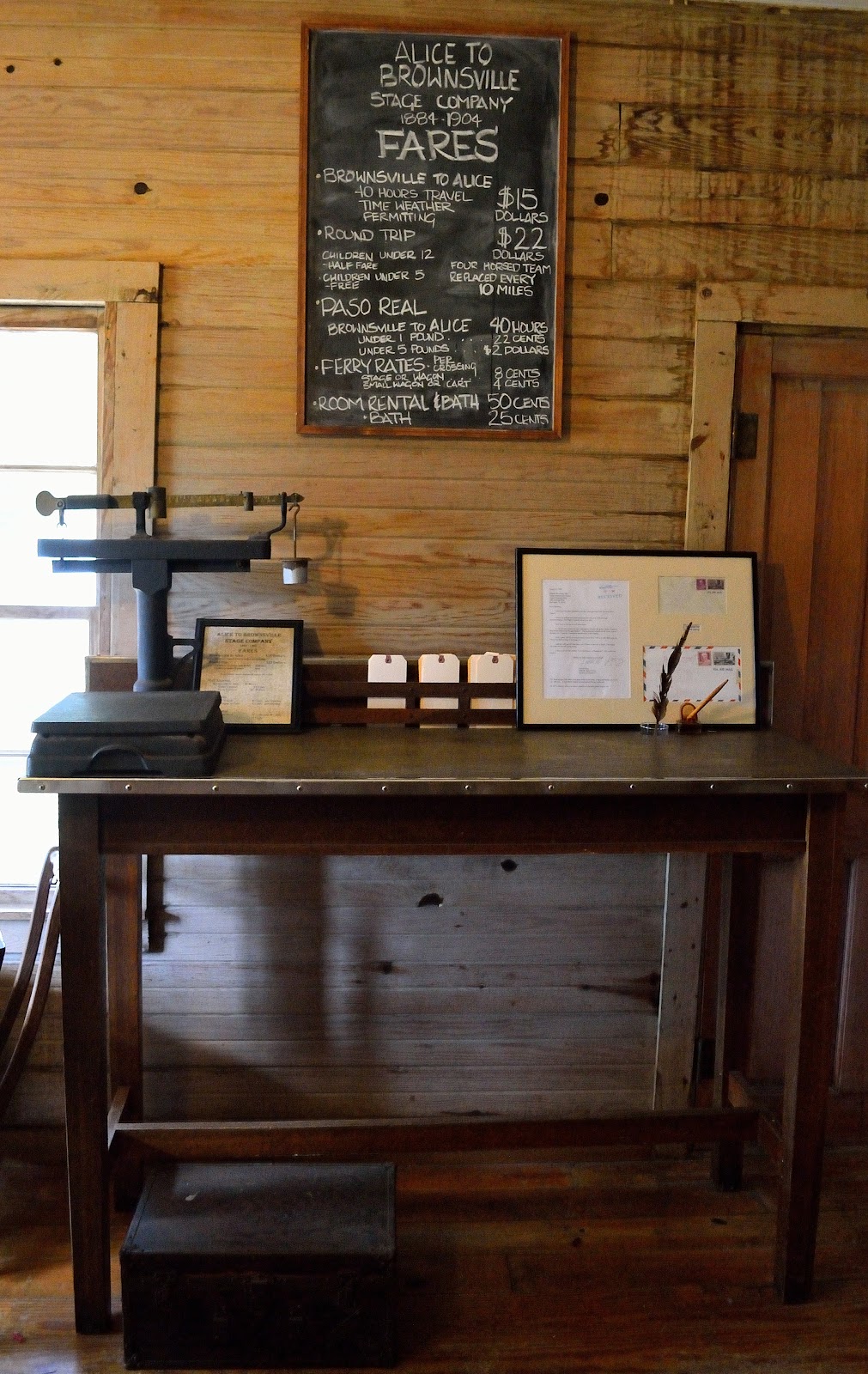
The last part of the museum was the Paso Real Stagecoach Inn. This is a replica built in 1978 by carpentry students using wood salvaged from the original. The original was built in 1850 on the Arroyo Colorodo River. It served as the way station for the stagecoach from Alice to Brownsville. Rooms cost 35-50 cents per night. Meals consisted of beef jerky, beans, tortillas, and milk. It was also the receiving place for Harlingen mail. In 1904 the railroad arrived making the way station obsolete.
This was a pretty cool museum all-in-all. Many of the artifacts were not under lock and key. They encouraged us to look in the early books or touch the bricks made by Hill himself. Can't say that about many places.
When Susan and I have an opportunity to be out on the water we usually jump at the chance. While at the Rio Grand Valley RV Show one of the exhibitors was Breakaway Tours. For $40 they offered a tour which included the Port of Brownsville shipping channel, Brownsville Shrimp Basin, dolphin sightings, and birds. After a short discussion with our friends we decided it would be a great opportunity not to mention fun. So, I was left with the task of wheeling and dealing a better price. Not sure how that task was bestowed on me but it was. I was able to get the 4 hour boat trip down to $30 each. They were all happy so we signed up. Did I mention it included lunch which consisted of all you can eat shrimp. Oh, and all the beer you can drink. I knew this would be the highlight of our friend Bob's trip.
It was a typical Texas winter day bright, sunny, windy, and cool. That did not deterred any of us, we just dressed like Canadians.
The first interesting point was the start or end, depending on which way you're headed, was the intracoastal waterway. This waterway is a series of canals, inlets, bays, and rivers that runs the length of the eastern seaboard from Norfolk, VA to the Florida Keys and along the Gulf of Mexico from Apalachee Bay, FL to Brownsville, TX. The concept of an intracoastal waterway was first introduced in 1808. Travelling these navigational routes either by commercial barge or pleasure craft provides a safe environment away from the hazards of the open sea. The entire intracoastal waterway involves a journey of over 3,000 miles.
Shortly after leaving the dock the beer was flowing and everyone was having a good time. I abstained since drinking and boating do not go together for me. As we left the dock I was amazed at how shallow the water was. Some places it was a foot others 2 feet. However, the actual shipping channel has an authorized depth of 42 feet. The turning basin is 36 feet deep and has a width of 1,200 feet. Enough room for these big boys to turn around. This one was empty.
As we passed this big ship navigating the channel I was amazed at the tidal wave it was creating. No wonder all the birds were following it out to sea. It stirred up all the sea life creating an easy meal.
Our tour took us into the Shrimp Basin. This is where approximately 250 shrimp boats call home when they are not out shrimping in the Gulf. These larger boats are out to sea for 50-60 days at a time and away from home 220-240 days of the year. Each boat holds 10,000-20,000 gallons of diesel fuel. This Gulf shrimp boat was in dry dock.
Many of the boats stay in the water to be fixed or completely overhauled. Most of the boats are out in the Gulf fishing. When they are in we were told that they are 3 & 4 deep tied up at dockside.
After touring the shrimp basin our Captain took us out into the shipping channel where we had lunch which consisted of Gulf shrimp, corn, roasted potatoes, salad, buns, and more beer. The food was okay. Being out on a cool day everything was cold plus the shrimp was way overcooked.
As we continued on into the shipping channel we were told that taking pictures was a no-no. Something to do with the Border Patrol, the Harbour Patrol, and every other patrol you can think of. So I was able to take a picture before entering into the no-picture zone. All these old naval ships are being broken down for scrape metal including the aircraft carrier from the movie Top Gun, the USS Ranger. At this point my heart fell out of the boat. This is my all time favorite movie. To know that the ship no longer exists...the movie will never be the same. I'm sure I will get over this trauma. You can see her in the background. One big hunk of scrape, I'm crying inside.

On our return trip we entered the intracoastal waterway travelling the channel between Port Isabel and Long Island. The only way across to the gated community of Long Island is via a "swing bridge". The swing bridge in its closed position allows vehicle traffic to cross over the waterway onto the island. Open position vehicular traffic is stopped allowing water traffic to continue along the intracoastal waterway. The Long Island swing bridge has been operating continuously since 1950.
As our tour drew to an end we were able to see some dolphins playing in the water. If you have ever tried to take a picture of dolphins you can understand why there are no pictures. Most of the time you get a whole lot of nothing. Here's a picture of South Padre Island skyline somewhere there's a dolphin under water.
Have you ever wanted to attend a bull fight? I haven't because I know how it ends. Meaning, there's allot of blood and a long drawn out inhuman death for the bull. If the bull is lucky the matador is defeated and the bull is put out to pasture to live a long and happy life with all those cows. United States does not allow bullfighting in the way we know it. However, they do allow bloodless bullfighting and we just happen to be an hour away from the one and only. The bullfighting arena is in the small town of La Gloria, Tx which happens to be north west of McAllen. I'm always up for something new and unusual so why not. It should be a fun afternoon.

What does bloodless bullfighting mean? Just as it sounds, the bull is spared. There is no lancing of the bull by the picadors and no faena-the fight to the death. Instead of using a sword the matador must grab a rose taped to the "kill spot" on the bull's back. Once the rose is grabbed the fight is over. Getting that close to the bull makes it even more dangerous for the matador. I would want to pray before getting into the ring with a bull. I think I will pray anyway, not sure for the bull or the matador.


The bulls used in the ring have the same lineage as the bulls used 1500 years ago in Spain, where the art of bullfighting originated. The bulls are four years old, full grown, and weigh approximately 400 kilos. These bulls are grandsons of Clarenero, a brave bull that was pardoned in Spain over 15 years ago. Clarenero was sold to a ranch in Mexico. The owner of Santa Maria Bullring, Fred Renk bought one of Clarenero's sons creating his own line of fighting bulls. These guys were patiently waiting their turn.
The place was nothing fancy by any stretch of the imagination, actually it was quite interesting. The seating was pretty rustic as was the equipment used to drag the arena.
The place had everything you needed to enjoy an afternoon of bullfighting. Food, beer, bathrooms, and entertainment. What more could you ask for. A young lady entertained us with some mariachi music while dancing horses strutted their stuff.

Each fight was about 20 minutes long. The first matadors of the day was Cesar Casteneda, the fourth ranked bullfighter in Mexico. Half way through, the bull was able to catch Cesar off guard.
It all ended well no one got hurt. Well, maybe the matadors pride. Anyway, he was able to snatch the rose from the bulls back and live to bullfight another day.
We watched a total of 4 bullfights and all were different and entertaining. Your probably wondering what happens after the bullfight? Well, you would think that they would use the bull again. Nope! No fighting bull is ever used twice in the ring. That's because the bull learn as much in 20 minutes in the ring as you or I would learn in 20 years. If the bull is put in the ring a second time, there would be certain death for the matador. Once the bullfight is over, the bulls are sold to rodeos. They are ridden by bull riders or they are used in Cowboy Poker events where four cowboys are sitting at a table in the middle of a ring playing...of course poker. The bull is let in with the sole purpose is to unseat the poker players. The last remaining seated cowboy is the winner. Does not sound like something I would play.
All in all it was a great day of fun and entertainment. The not so fun part was driving home in the dark on back country Texas roads.
What does the Battle of Iwo Jima and Harlingen, Tx have in common? Why am I talking about Iwo Jima when we are thousands of miles away. As you continue to read I will answer these questions and more but first here is a little history lesson.

The island of Iwo Jima is a volcanic island located in the South Pacific approximately 660 miles south of Tokyo, Japan. The island itself is 2 miles wide and 4 miles long. Not very big but very strategically located during WW II being midway between Japan and the US bomber bases in the Marianas.
The need for the United States to occupy Iwo Jima came from the inability to defend against attacks on the long range B-52 Superfortresses by Japanese fighters.
 General Kuribayashi, the Japanese Commander in charge of Iwo Jima had unique strategies to fight this battle. Firstly, the Japanese did not fight above ground. Their entire battle was fought from below ground. They dug 16 miles of connecting tunnels in the rock with over 1500 rooms. Kuribayashi's cement command center had 5' thick walls, a 10' thick roof, and was under 75' of solid rock. Secondly, Japanese strategy called for no Japanese survivors meaning all would perish. Lastly, each Japanese soldier would kill 10 Americans before being killed themselves.
Below is one of many bunkers in Iwo Jima severely damaged by military shelling. Also, a picture of one of many catacombs in which the Japanese sought shelter.
The U.S. invaded Iwo Jima on February 19, 1945 after months of naval and air bombardment. Over 70,000 Americans and 18,000 Japanese soldiers took part in the battle. In 36 days of fighting nearly 7,000 Marines were killed and 20,000 wounded. The Marines captured 216 Japanese, the rest were killed in action. The island was officially declared secure on March 26, 1945.
On February 23, 1945 five days after the battle began, an American flag was raised atop Mt. Suribachi. Associated Press photographer Joe Rosenthal took the famous photograph which became an image of heroism and bravery. From this iconic photograph, sculptor Felix de Weldon was so moved he made a scale model with 48 hours. Nine years later the plaster model was completed, disassembled, and shipped to Brooklyn NY for bronze casting. From NY the bronze casts were shipped to Arlington National Cemetery for assembly.
In 1981 de Weldon gifted his original full sized working model to the Marine Military Academy (MMA) as an inspiration to young cadets. And where is MMA? But of course Harlingen, TX.
The 32 foot high figures are erecting a 78 foot high steel flagpole from which the flag is flown 24 hours a day. The base is made from black Brazilian granite. The 6 individuals raising the flag where Sgt Micheal Strank, USMC; Cpl Harlon Block, USMC; PFC Franklin Sousley, USMC; PFC Rene Gagnon, USMC; PFC Ira Hayes, USMC; and PhM 2/c John Bradley.
The Marine placing the flagpole into the ground was Cpl Harlon Block a South Texas native from Weslaco, TX. Killed in action days after the famous picture was taken, Blocks final resting place is at the base of the statue.
The museum was so worth the time spent seeing several artifacts and memorabilia from the war. There was an amazing 30 minute film recounting the Battle of Iwo Jima. But the most moving moment was walking next to this larger than life memorial.
Susan couldn't help herself when she saw this beautiful cat. Her name is Heather, so if you're visiting the museum look for her (the cat not Susan) roaming around just looking for a little lovin'. If you see Susan give her some lovin" too.