Showing posts with label Florida. Show all posts

Wednesday, January 17, 2024

Part 2 - Nike Missile Site HM-69 Everglades NP

 "It is insane that two men, sitting on the opposite sides of the world, should be able to decide to bring an end to civilization."
-John F. Kennedy, 27 October 1962

At the height of the Cold War, a United States spy plane photographed a Soviet missile site in Cuba on 14 October 1962. President John F Kennedy was informed of these missiles, which had the capability of delivering nuclear warheads to major US cities possibly killing millions. At the time United States was poised only to defend an attack over the North Pole by the Soviet Union. The Cuban Missile Crisis revealed south Florida as an "Achilles heel".

In response the US Army Corps of Engineers chose to build an anti-missile site called HM-69 within Everglades National Park 160 miles from the Cuban coast. The area contained 22 buildings including 3 missile barns, a missile assembly building, a guard dog kennel, and barracks. The command centre was one mile away from this site.
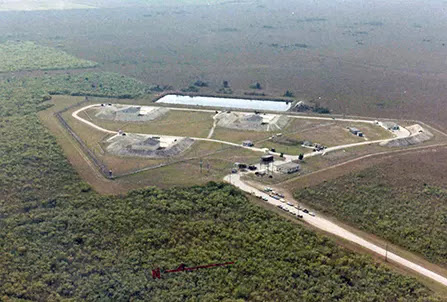
Photo Courtesy of NPS
The US Army's 2nd Missile Battalion, 52nd Air defense Artillery had the daunting task of maintaining the 41 foot Nike Hercules missiles in constant readiness. Some missiles were equipped with nuclear warheads ranging up to 40 kilotons which was 3X the power of the Hiroshima bomb.
Photo courtesy of NPS
Sign posted at entrance gate to Nike Missile Site
Today the site remains virtually the same as when it was decommissioned in 1979. Barn C is now a museum with an original Nike Hercules Missile and tons of information on the missiles and the Cuban Missile Crisis.
Nike Hercules Missile

Part of the Remaining Dog Kennels
Touring the now HM-69 missile site museum was quite an experience. I was pretty young when the Cuban Missile Crisis started and frankly knew nothing about it until high school. At the time life just carried on. The Beatles released their first single "Love Me Do", the Yankees beat the Giants in the World Series, and Sean Connery starred in the first James Bond movie "Dr No". I'm sure we remember at least one of these events if not all. But do we remember when the world or life as we have come to know it almost came to an end. Something to think about.

A very special thanks to my friend Rick M in Florida who was stationed at HM-69 during these days of uncertainty. Thank you for your service.

Saturday, January 13, 2024

Part 1 - Everglades National Park, Florida

Visited: 7 - 12 January 2024
Nights Stayed: 5 nights

Known as "the river of grass", the everglades is home to 450,000 acres of mangroves and the largest continuous seagrass meadow on earth. When people think of the Everglades usually it's birds, alligators, snakes, and water. When I think of the park I think of an abundance of trails to explore, wide open spaces that are endless, and reptiles & animals galore. The park did not disappoint.

Everglades National Park is the third largest park in the continental United States only beaten by Death Valley and Yellowstone. It covers over 1.5 million acres or 2,350 sq miles. The elevation ranges from 0 to 8 feet (2.4 m) above sea level. The Florida Peninsula is thought to have appeared above sea level about 100,000 to 150,000 years ago. 

It is thought that humans first inhabited the area 10,000 to 20,000 years ago. The Tequesta tribe developed the eastern side while the Calusa (whom my dog was named after) inhabited the western side.

The Everglades was established as a National Park  in 1947. UNESCO listed it as an International Biosphere Reserve in 1976. In 1979 it was also listed as a World Heritage Site.

On average one million people visit Everglades NP each year. However, road access is limited to only four areas of the park. They include Shark Valley, Gulf Coast, Royal Palm, and Flamingo. The last is where we spent 5 glorious nights camping. FYI contrary to what many believe, we did not see a python around every corner, as a matter of fact we did not see one at all. 
Below is a map of Everglades National Park outlined in red. The only road leading to Flamingo is in orange and the star is where we camped for 5 nights.

Entrance gate to Everglades National Park

Flamingo Area - Everglades National Park

Flamingo Campground
There are basically two seasons in the everglades, the wet season and the dry season also known as tourist season. Most tourist visit the everglades between November and April of each year. This campground is usually booked solid a year in advance. We had a 30 amp electric site. Water fill-up is at the bath houses along with a dump station. The dry season gives way to the wet time of year. This sees a drop in visitation namely due to hot humid weather, supersized mosquitoes, and a constant threat of severe thunderstorms. Also the campground is closed during these months.

Our site
The first place I checked out was the Guy Bradley Visitors Center which is located near the campground but a 38 miles drive, bike, or walk from the entrance to Everglades National Park. It consists of two buildings joined by an above ground walkway and viewing area. This is a great place to start your adventures, the marina is close by, trails start from here, and several ranger lead programs are held in the visitors center or close by. 
Guy Bradley Visitors Center in Flamingo
For those who choose not to camp, the newly constructed Flamingo Lodge provides nightly accommodations that overlook the bay. The newly opened Flamingo restaurant which is adjacent to the lodge is open for breakfast, lunch, and supper. A bar service is also available.  
Flamingo Lodge

Flamingo Restaurant
The wildlife is amazing in Everglades National Park even though the weather wasn't great while we were there. It's suppose to be the dry season we received rain each day. So much so they closed the Bayside campground. I found this osprey and black vulture duelling it out along bayside.
Another accommodation choice are the elevated glamping eco-tents. Each has a partial view of the bay with either a queen or two single beds.
Glamping Eco-tents

View of Bay 
This coastal prairie is the result of numerous hurricanes storm surges that have swept across Everglades National Park. The water smothers the tree roots with a sediment that kills the mangroves. The damage promotes new plant and animal life where perching birds, snakes, lizards, and field mice thrive.
Coastal Prairie
The marina is the hub for all things water related from house boat rentals to boat tours. A marina store provides a variety of snacks, camping needs, souvenirs, and gasoline for your boat. Its also a great place to see crocodiles...yes not alligators but crocodiles. This is salt water a place alligators prefer not to go. I was lucky enough to see two.
Flamingo Marina
This crocodile is easy to identify due to his deformed jaw
Crocodile sunning himself of the boat ramp

Sunday, April 9, 2023

Florida Caverns State Park

 Length of Stay: 2 nights

Our next stop on the way home is Florida Caverns State Park, another park we have not been to. This park is located in the panhandle near the small town of Marianne on the Chipola River. People have been exploring this wonderful park since the 1930's. But, on October 18, 2018 this all came to a screeching halt. Hurricane Michael a category 5 hurricane ripped through the park destroying 90% of the tree canopy and much of the infrastructure. The campground closed, river access suspended, the cavern was filled with silt and debris making it impassable.

With hard work and determination the campground and caverns reopened on 1 October 2021. With my tour of the cave set for Sunday I went exploring today. The campground itself contains 32 sites with full service meaning 30/50 amp hydro, water, sewer, picnic table, grill, fire pit, and cloths line. 


The park indicates that sites can only handle RVs up to 32 ft however, I saw 40 fters and they had no issue in/out.  Equestrian camping is located away from the main campground and have both water/power. The Blue Hole swimming area has very dark water and is approximately 35 feet deep. No lifeguards are on duty. Yes, alligators are here.

The visitors center was built by the Civilian Conservation Corps in 1942 as part of President Roosevelt’s New Deal project. This limestone structure houses not only a gift shop but a self-guided museum with plenty of exhibits and is the staging area for cave tours.


I booked my cave tour online about 2 months prior to our arrival and was glad as the tour was totally booked. Our guided tour began with a walk to the cave entrance which was not strenuous, then down 35-50 steps. Prior to this the guide spelled out all the do's and 
don'ts while in the cave.


I have to admit this is the first cave I've been in where my glasses steamed up. The cave is a humid 65 degrees year round. The tour is not long and takes 35-40 minutes. The rooms contain formations such as stalactites, stalagmites, columns, soda straws, ribbons, and draperies. These formations were created over tens of thousands of years when surface water seeped through the limestone rock dissolving the calcium. As the water which contains dissolved calcium drips from cracks in the ceiling, stalactites are formed. Water laden with calcium dripping from stalactites form stalagmites.

Anyone that is claustrophobic would have a problem in this cave. The ceiling is 4' high in areas and the walls only 2' wide. This is a very wet cave and can be quite slippery in places. The exit is pretty much the same as the entrance. All in all great experience.

Many wildflowers appear at different times of the year. Southern magnolias, a native evergreen tree grow in abundance in this area and can reach 60 to 80 feet.


This is where the Chipola River flows underground through a cavern and resurfaces 1/4 mile downstream. During high water the river continues to flow above ground. In the early 1900s, loggers cut a ditch across this natural bridge to float logs downstream. Note the brown sign upper right..."1975 high water marker".

With the exception of the road being washed out in a couple places, this is a fantastic park. Alot of thought and planning went into the rebuilding of this wonderful state park. We will revisit it again.

Friday, April 7, 2023

Ruth B Kirby Gilchrist Blue Springs State Park

Length of Stay: 1 night

Gilchrist Blue Springs State Park is about 5 miles west of High Springs located along the Santa Fe River. For many years it operated as a private park with canoeing, snorkeling, and swimming being the main draw. In 2017 the state of Florida purchased the land and opened it as Florida's 175th state park.

The park has a collection of natural springs which includes a second magnitude spring which produces on average 44 million gallons of water daily.

This stopover was for one night as we make our way home. The road getting to the campground is sand making it very tough to drive through. Thank goodness for 4 wheel drive.

The park features 23 campsites with 16 sites for RV/tent and 7 for tent only. Each RV site has 30 amp power and water. Power is really, really bad but we were able to use our AC because it was sooooo stinking hot.


The big draw is of course the springs. On a hot day locals flood here to cool off and picnic in the park. This was quite evident by the line up at 9 in the morning to get a prime location for the family picnic.

Before leaving I talked to one of the rangers who happened to be very informative and extremely nice. The park is slated for a complete makeover by Florida Parks. When that happens I can see it being quite the destination park. But for now it's a one and done.

Saturday, February 11, 2023

Lake Kissimmee State Park, FL

Lake Kissimmee State Park is a 5,930 acres park approximately 2 hours south of Orlando. The park is surrounded by three lakes (Roselie, Tiger, and Kissimmee) and collectively are known as the headwaters of the Everglades. The state purchased 5,030 acres in 1969 from the William Zipperer estate. The park opened to the public in August 1977. In 1997 an additional 900 acres was purchased on the western boundary.

Lake Kissimmee State Park offers an abundance of outdoor activities including boating, canoeing, fishing, hiking, biking, and trails. The park has a 60 site campground all with water /electricity and 2 primitive sites. A dump station is conveniently located near the campground. Interior roads are paved and most sites are nicely shaded.

There is an abundance of wildlife which became quite evident early on. A white tailed deer greeted us as we were backing into our site. On a bike ride later that day I saw a plethora of birds and a bobcat ran down the road in front of me. 


During the Civil War the area was used to raise cattle. They would be shipped to the confederate army and/or traded to Cuba for supplies. A 1876 cow camp demonstrates the history and life of the early Florida cow hunter. Open on Saturdays from 10 am to 4 pm.


Resurrection Fern
Lake Kissimmee State Park has 5 well marked multiuse trails with a distance of over 20 miles. The Gobbler Ridge Trail, a 2.8 mile round trip trail starts at the main parking lot and leads to the observation tower. It's an easy trail to walk, riding a bike is a little more difficult due to white sand and very wet areas near the lake. The tower was blocked off half way up but I could still get a good idea of what the area is like. It is marked by green hash marks on the trees.
Lake Kissimmee
Florida Box Turtle

Nine-Banded Armadillo
Lake Kissimmee

The Buster Island Loop is also a well marked 6.7 mile multi use trail that is an actual island. It is marked with white hash marks on trees. The trail starts at the Zipperer canal bridge and meanders through live oak forest.
Almost drove over this little guy on my bike
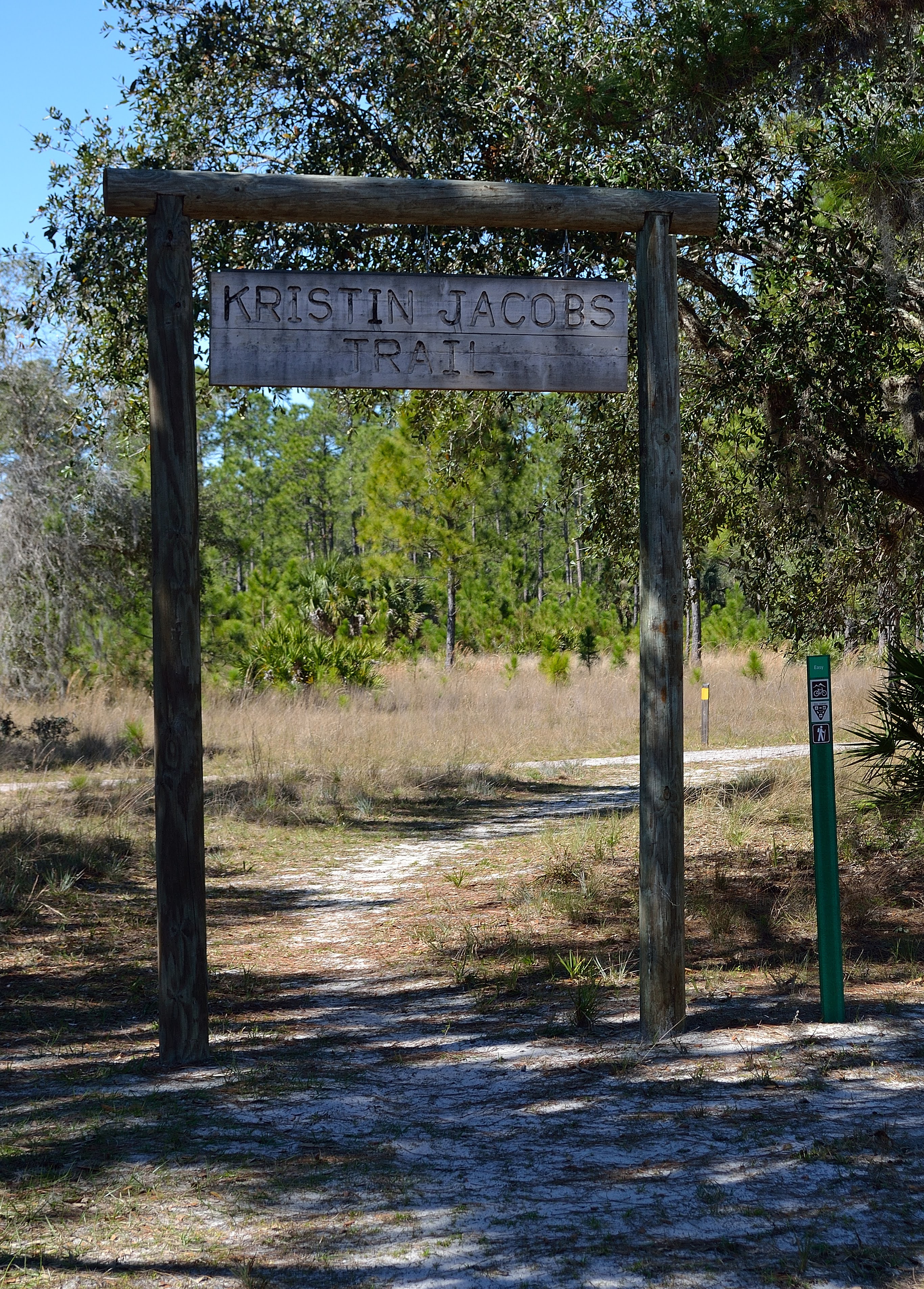
Even though this trail was well marked somehow I lost it and ended up on the red trail which is the equestrian trail. It all ended well. I rode back to the trailer for some much needed lunch. Because this is our last day at Lake Kissimmee I wanted to explore the last remaining trail. So after a very short nap I set out for the 6 mile Kristin Jacobs or yellow trail.
Someone found time to make this
I have to admit there was some apprehension about this park. The reviews were not great. The biggest complaint was the constant airboat noise. During our four days I heard only two airboats and they were the sheriffs department doing patrols out on Lake Kissimmee. It was so peaceful you could hear yourself think. How nice is that. Another fantastic state park explored.