Saturday, November 10, 2012

Discovering Cub Run Cave

 I must admit I was a little disappointed with the previous cave we explored. So, I needed another cave fix. Susan had enough cave exploring so I ventured out on my own but first which cave needed explorin'. I decided on Cub Run Cave because our guide at the previous cave could not say enough about it. So off I went. The drive was beautiful through the Kentucky countryside. The leaves had mostly turned colour and fallen allowing one to see further without tree and leaf obstruction. It was also a beautiful sunny warm day but that wont matter since I'm underground. Cub Run Cave was first discovered in August 1950 by Kenneth Childress and his 16 year old cousin Rancel Logsdon. The cave was opened to the public shortly after discovery but closed a year later due to land disputes. It remained sealed for more than 50 years but reopened to the public in July 2006.


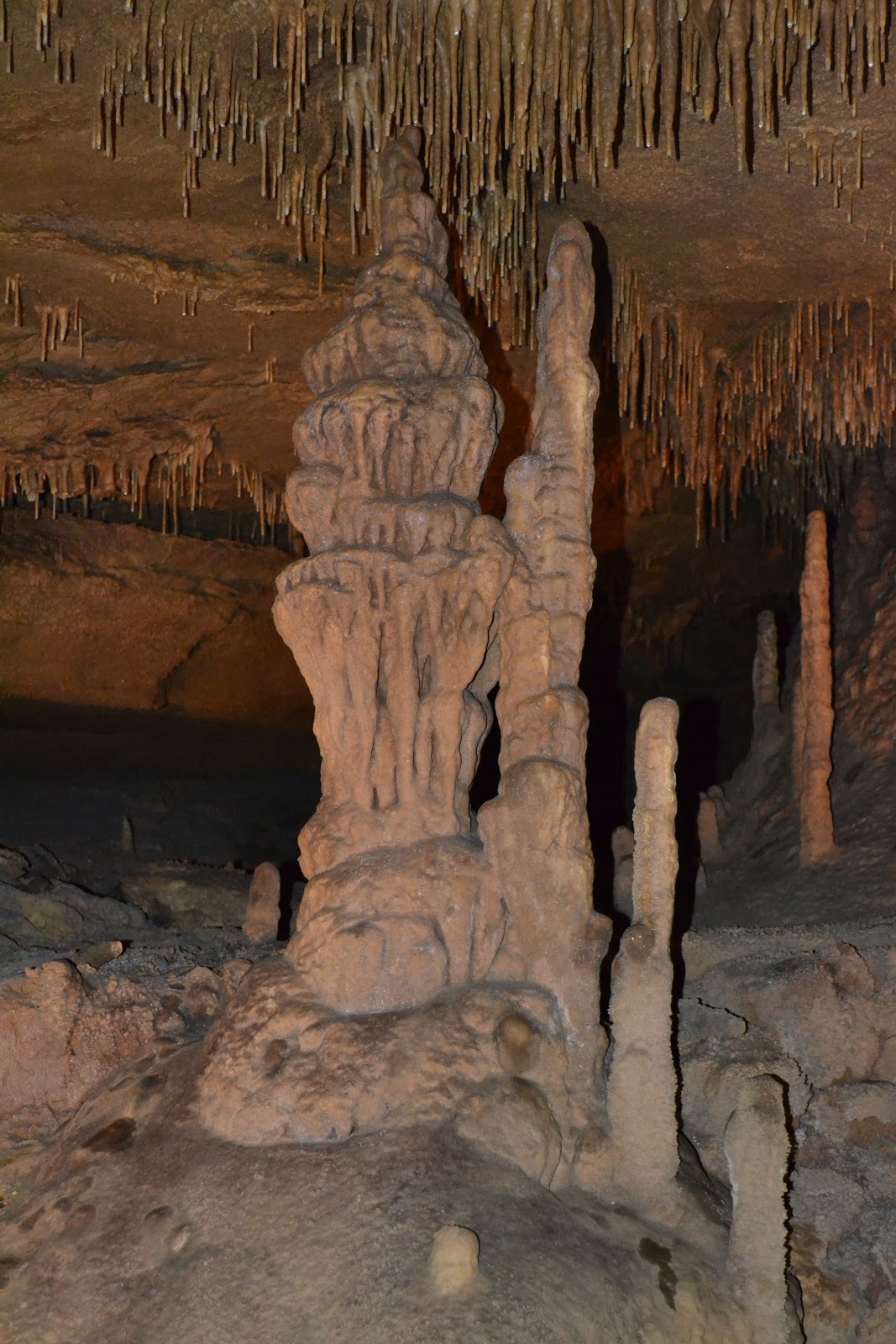
Cub Run Cave is a half-mile long with elevated wooden walkway which traverses through beautiful formations such as flow stone, cave bacon, cave coral, stalactites, stalagmites, and more.
 
Rocky outcrop overlooking entrance to cave
Creek flowing from original opening
 
Formation on ceiling caused by water flow


Elusive cave crawfish


Cave Cricket
Dips from cave ceiling cause concentric circles every few seconds


Cave Salamander

Friday, November 9, 2012

Munfordville, KY

Today I wanted to explore some local history, so Munfordville was the place I started. Munfordville abounds with history and is clearly evident by the architectural buildings that remain standing from the 19th century. In 1801 Richard Munford settled on the Green River at a site known as Big Buffalo Crossing. By 1816 a thriving town was established bearing Munford's name.

The Woodson House was the home of Anthony and Eliza B. Chapline Woodson 

The Woodson House and Farm was of strategic importance during the Civil War due to its close proximity to the massive Louisville-Nashville Railroad Bridge over the Green River. Because of this many resident's homes and buildings were requisitioned by the Union military. Scores of acres of prime timber were cut for lumber and fuel. Fortifications were built and a network of roads criss-crossed through what was once fertile fields.


Leaving the Woodson homestead and driving toward the town of Munfordville I saw in a distance a very strange rock formation. This formation is known as the Kentucky Stonehenge created by a local named Chester Fryer.


Chester Fryer scoured the Hatcher Valley for the rocks that created his masterpiece. The Kentucky Stonehedge does not exactly resemble the real one but rather it reflects points on a compass.


The town of Munfordville is filled with turn of the century buildings and unique gift shops stocked with local Amish jams and jellies.

Chapline Building
The Chapline Building located in the center of Munfordville was contructed in the 1890s. The brick used to manufacture the building was from native clay.


Wood House circa 1834


Presbyterian Church/Union Hospital circa 1834

Village School/Nurse's Quarters circa 1833
Originally consisting of two separate brick chambers, the structure supplemented the field hospital church across the street during the Civil War. After the war the structure was used as a school, one room for girls the other for boys. In the 1900s the rooms were joined and converted into a private home.


Hart County Courthouse

Circa 1910


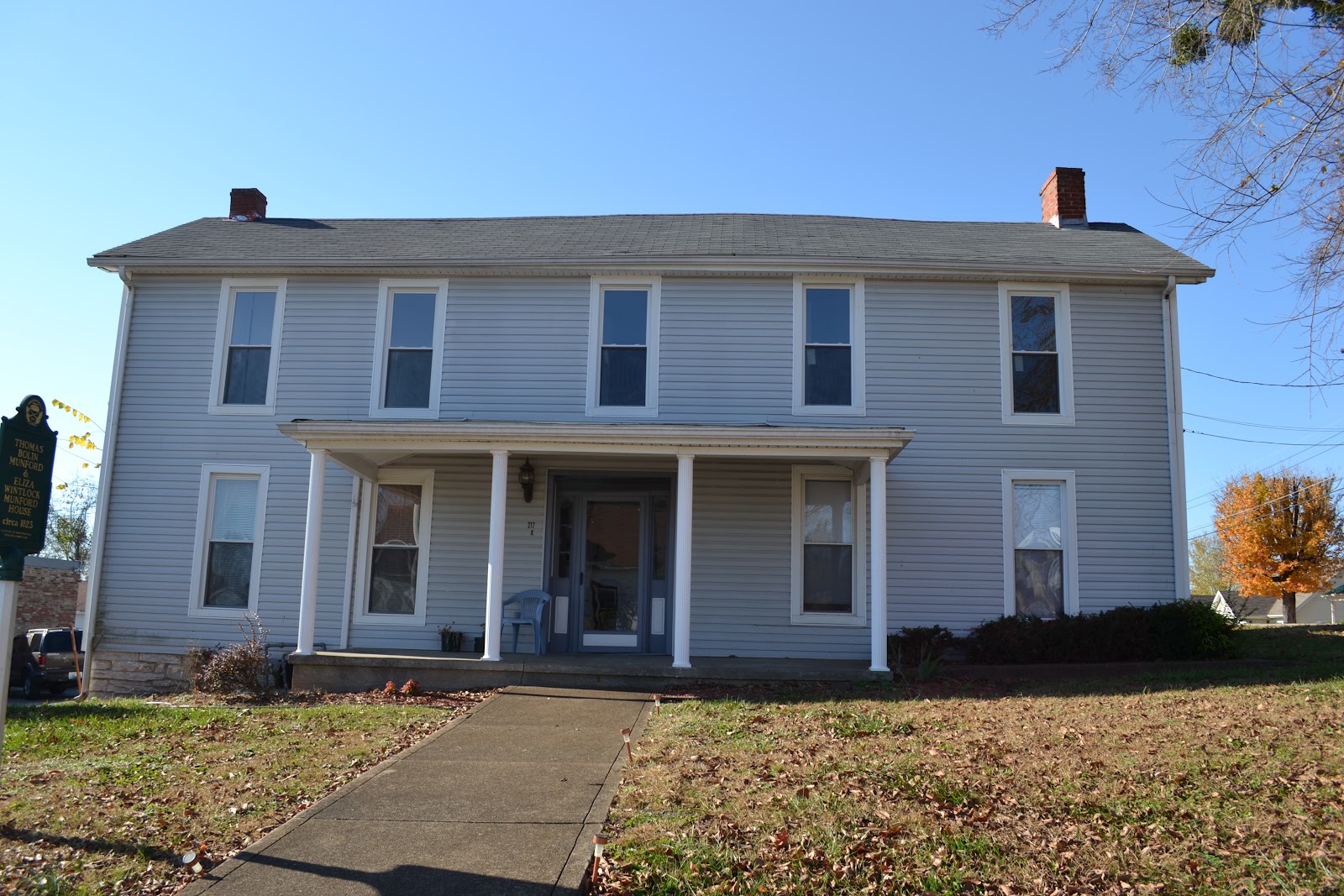
Thomas Bolin Munford & Eliza Wintlock Munford House circa 1823
This home predates all the brick homes in town. Underneath the present exterior are logs and the interior walls are 16 inches thick.

Thursday, November 8, 2012

Dinosaurs & Caves


Today will be another milestone for Susan. We are going spelunking. Deciding on what cave to see will be the only challenge for me as I love caves. After much thought and debate we decided on the American Cave Museum and Hidden River Cave in the town of Horse Cave, Kentucky. Horse Cave is best known for the large natural cave opening in the middle of town. Historically, Horse Cave is a major agricultural center since the 1870s. Tobacco provide the majority of income with evidence scattered around the country side. Tourism now supplies a major income as people flock to see the museum and cave.


Hidden River Cave opened for tours in 1916. Over the next thirty years town's growth and poor sanitation practices caused a festering corrupt mess through the dumping trash and allowing raw sewage to run into the cave river system. According to our guide history indicated that by midday the smell would be so bad the stores across the street would close. Consequently, the cave closed for more than fifty years reopening in 1993 after the American Cave Conservation Association provided extensive cleanup.
Large sinkhole that drops 3 storeys from street level and provides the entrance to the cave


Entrance to Hidden River Cave


Descending 150' underground

Remnants of the turn-of-the-century hydro-electric generating system


Old electrical system in ceiling of cave


Old pumping system provided water for Horse Cave


Leaving the cave

For people that truly know me, know that one of my passions is dinosaurs. So another reason to stop in Cave City was to venture through Dinosaur World. Dinosaur World was the brainchild of Christer Svenson of Sweden more than 15 years ago. Opening in June 2003 Cave City Dinosaur World is the second of three, Florida and Texas being the other locations.


Over 150 life size dinosaur models


Sue look up

The dinosaur models are made of fiberglass, steel, and concrete


Nestled among the lush assortment of natural vegetation and water features creates a life likeness for each dinosaur

Not only was I thrilled with the dinosaur displays but to my surprise the number of wild birds present in the park.

Carolina Chickadee

Tufted Titmouse

Carolina Wren

Wednesday, November 7, 2012

The Land of Corvettes and Caves

We decided the first major stop on our trip south would be the land of corvettes and caves. Appropriately named for the corvette museum/assemble plant and the numerous caves in the region. Cave Country Campground in Cave City KY is home for next 5 days while we explore the area. A beautifully laid out campground close to everything we want to see and do.


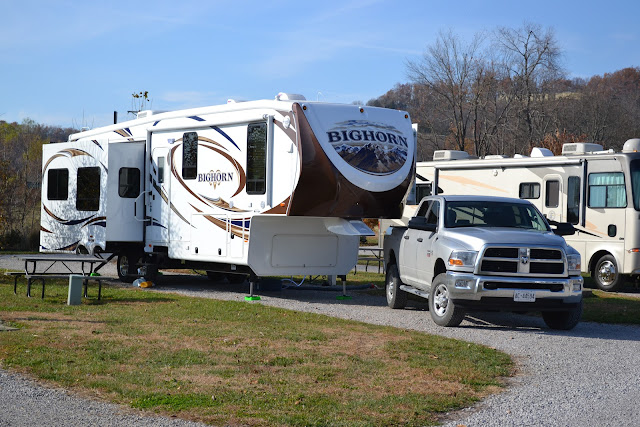
Cave Country Campground


Our Campsite #18
 

A trip to this area would not be complete without a visit to the National Corvette Museum(NCM) in Bowling Green, KY. The newly expanded NCM is over 115,000 sq ft with more than 80 different corvettes on display at any given time. The corvette was originally built in Flint, Michigan and St. Louis, Missouri and now across the road at the Bowling Green assembly plant. If you are a true corvette lover you can wonder across the street to watch a corvette being built. The first model corvette was a convertible and rolled off the assembly line in 1953.You would think that everyone in this town would be driving a vet but not so.


Faith Hill's 1960 Corvette on loan to NCM


What a great place to spend a cold rainy day. After 2 hours we were all corvetted out. While in Bowling Green we decided to explore the city. The next stop was The Historic Railpark & Train Depot, formerly known as the Louisville and Nashville Railroad Station. It was placed on the National Register of Historic Places in December 1979. The current depot, constructed of limestone was opened October 1925.


By the 1960s passenger train service began to decline due to the popularity of air travel. Amtrak replaced the L&N passenger service in 1971. The last passenger train departed the depot October 1979. Some of the rail cars are still present at the depot today.

L&N 796 E-8 Engine


L&N 1107 Railroad Post Office Car built in 1921
 is one of only two remaining mail cars from the first 18 commissioned in 1913


L&N 353 The Office Car built in 1911
was intended for the L&N Railroad President and high-ranking officials
 

Another stop while in Bowling Green was Riverview at Hobson Grove. This beautiful Italianate designed home with arched windows and ornamental brackets was built for Atwood Hobson and his wife Juliet van Meter Hobson. Construction was started in the 1850s, but halted due to the outbreak of the Civil War. Riverview was finally completed in 1872. The Hobson family and their descendants lived in the house until 1952.


Riverview at Hobson Grove


Property surrounding Riverview


Leaving Riverview behind we ventured into the downtowwn area where we came upon a really cool old gas station. This gas station was constructed in 1921 and was the first station in Kentucky.


Standard Oil Filling Station No. 1


Checkout the gas prices