Wednesday, July 4, 2018

Day 37 - More Fairbanks, AK

Today is the day we go to the University of Alaska Fairbanks Research Center to see Musk Ox. This research facility the only one of it's kind in the world, is responsible for maintaining a healthy colony of muskoxen for nutritional, physiological, and behavioural research.

The Large Animal Research Station(LARS) sits on 134 acres of land north of the University of Alaska Fairbanks. The land was the homestead of the Yankovich family, who deeded it to the University in 1963.

In the mid to late 1800's muskox died off completely in Alaska. It was thought to be from climate fluctuations. At the same time the number declined in Canada. In 1930 34 young muskox were captured in Greenland and transported by dogsled, ship, and then larger ship. They spent time in quarantine in New York the trained to Seattle, WA. They were then put on a barge to Seward, AK. From Seward they were trained to Fairbanks and released into a large pasture. This trip took 4 months to complete and every muskox survived.

Qiviut(pronounced kin-ee-ut) is the under wool produced by the muskox. It is an extremely fine, soft, downy undercoat. The insulating warmth of qiviut is why muskox can survive Arctic winters. They have an outer coat of long, coarse guard hair that protects the under wool from the wind and snow. That is why they can live on the open Tundra exposed to the harsh cold extremes of the polar arctic.
LARS is also home to cariboo and reindeer. I saw this little one (young reindeer) playing, jumping, and kicking.
That place was so much fun. We went on the 40 minute tour which was very informative.

Even though it is late in the year, I was hoping to see some birds or other wildlife at Creamer's Field Migratory Waterfowl Refuge. But no such luck. I saw more Sandhill Cranes at LARS then here. The 1,800 acre refuge was established to preserve habitats for migratory birds, especially waterfowl.
Another great day in Fairbanks, Alaska.

Tuesday, July 3, 2018

Day 36 - Fairbanks, AK

Pioneer Park in Fairbanks opened in 1967 as part of the 100 year celebration of the purchase of Alaska from Russia. The park consists of 44 acres of land showcasing the history of Fairbanks. The property was given to the state of Alaska then transferred to the City of Fairbanks. Pioneer Park is open year round, 24 hours a day and has free admission. 
The Harding Car was built in 1905 in Chicago, Illinois and carried passengers until 1945. It was donated to the city of Fairbanks in 1959 and moved to Pioneer Park in 1965. The Harding Car also known as the Denali Car, is the car that US President Warren G Harding rode in when he came to Alaska in 1923 to drive the Golden Spike for the Alaska Railroad. The Golden Spike signified the completion of the 500 mile long line. Harding was the first US President to visit Alaska.
As we walked around the pioneer town Susan and I wanted to try our hand at dog mushing.
 The next cabin was brought to the pioneer village from 4th Avenue “Red Light District” in Fairbanks. A wood board fence at either end protected the innocent from views of debauchery.
The Loomis cabin is the oldest standing cabin in Fairbanks, it was constructed in 1903. Ike Loomis came north during the Klondike Gold Rush in 1898 and drove freight and supplies by dogsled. He was never robbed even though there were famous robbers and outlaws at the time. Jenny Loomis, Ike’s wife died in this cabin during the 1918 influenza epidemic that wiped out 20% of Fairbanks population.

In 1904 Loomis came up with the idea of making a reinforced courier transport to move freight and gold. Loomis moved to Portland, Oregon in 1925. Like the rest of the lower 48, Portland was experiencing an increase in bank robberies. Ike spent $5,000 making a reinforced wagon to carry money and gold. It became known as Loomis Security. Loomis is presently one of the largest armored car security companies in the world.
Located in the center of Pioneer Park, the SS Nenana is the largest steam-powered wooden sternwheeler ever built west of the Mississippi River and one of three of its kind left in the US.

Built in 1933 for the Alaska Railroad for service on the Yukon, Nenana, and Tanana Rivers, the SS Nenana could carry up to 300 tons of freight. Retired in 1955, she was brought to Fairbanks to be preserved.
This steam operated shovel helped build the Panama Canal, worked in Hawaii, and helped dig the Davidson Ditch, the Alaskan Water Pipeline. The Davidson Ditch was dug and brought water to float and operate the huge hydraulic gold dredges in the interior of Alaska.
We were all having so much fun getting our picture taken with all the wood statues.
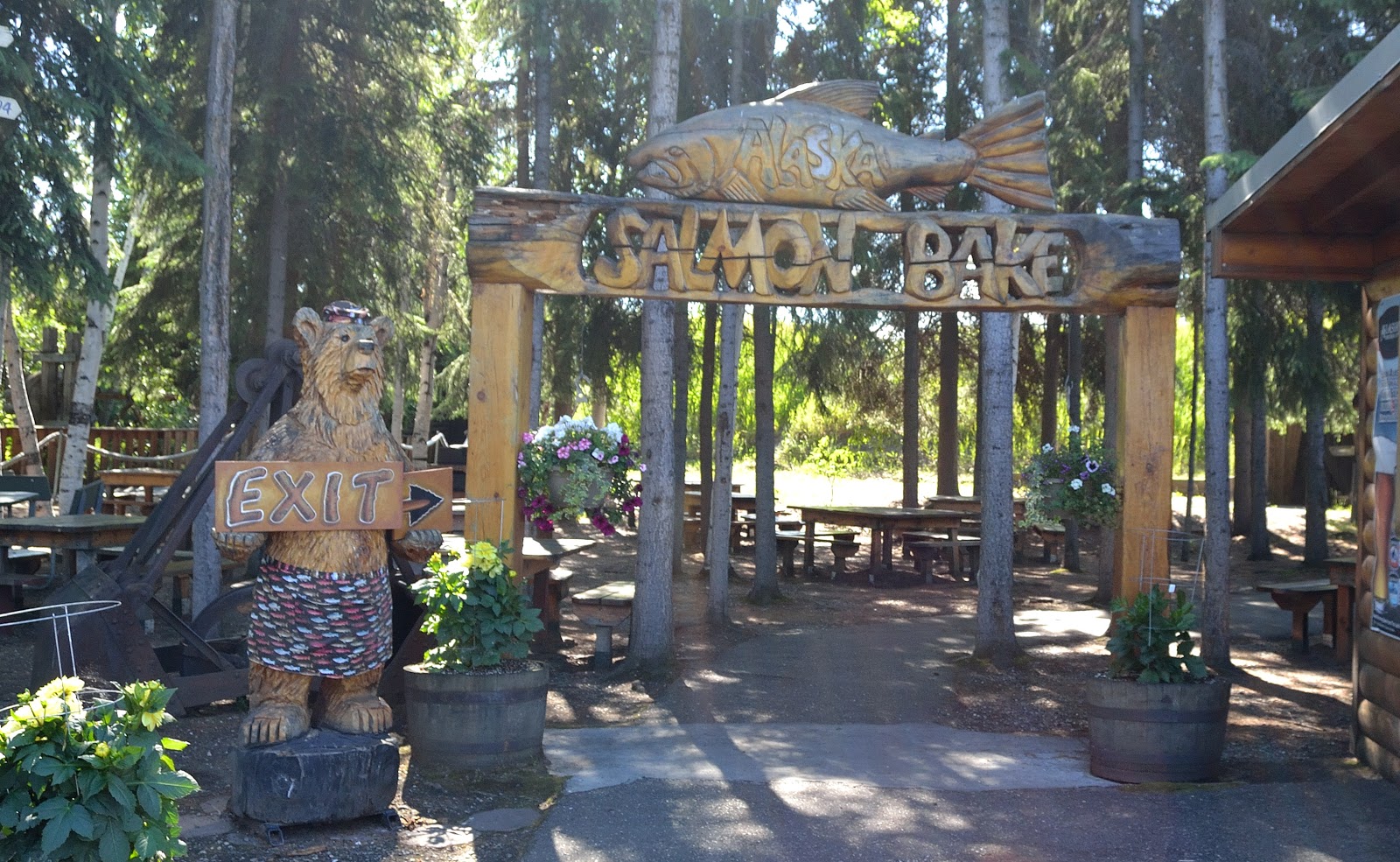
The Alaskan Salmon Bake offers all-you-can-eat fire grilled salmon, hand dipped beer battered cod, and slow roasted prime rib. It includes a full salad bar with roasted potatoes, cowboy baked beans, sourdough rolls, dessert, tea, coffee, and non-alcoholic beverages. Each entree is $35.95 for adults. Dinner is served from 5 - 9 pm daily.  So we all decided that since tomorrow night is our last night in Fairbanks we would come here to have supper. The menu looks amazing.


After an hour or more we went home to let the dogs out and relax. We made reservations for a cruise on the Riverboat Discovery at 2 pm. So after a quick turnaround we were off to our Chena River boat cruise. Sternwheelers, floatplanes, and dog mushing were once the main means of transportation in Interior Alaska.
In the 1940’s Captain Jim Binkley piloted freight vessels on the Yukon and Tanana Rivers. By the 1950’s the last of the steamboats had been retired. Noting the changes Captain Jim and his wife Mary began a river excursion business in Fairbanks in 1950. In 1955 he built the company’s first sternwheeler, a 150 passenger boat called Discovery I.
Discovery I
As the business grew, so did the fleet. In 1971, the 300 passenger Discovery II was put into service. In 1986, the 900 passenger 280 ton Discovery III was being built in Seattle Washington then shipped to Alaska in 1987. Even though Captain Jim has passed away (2003), his wife Mary remains quite active in the daily business. She is 94 years old.
Discovery II
Discovery III
We started our boat cruise meandering down the Chena River where we watched a bush pilot in his Piper Super Cub take off and land on the water.
Well that was pretty amazing. We continued down the river  and paused at Trail Breaker Kennels, which is the family home of the late four time Iditarod Trail Sled Dog Race Champion Susan Butcher. We finally got to see some puppies.
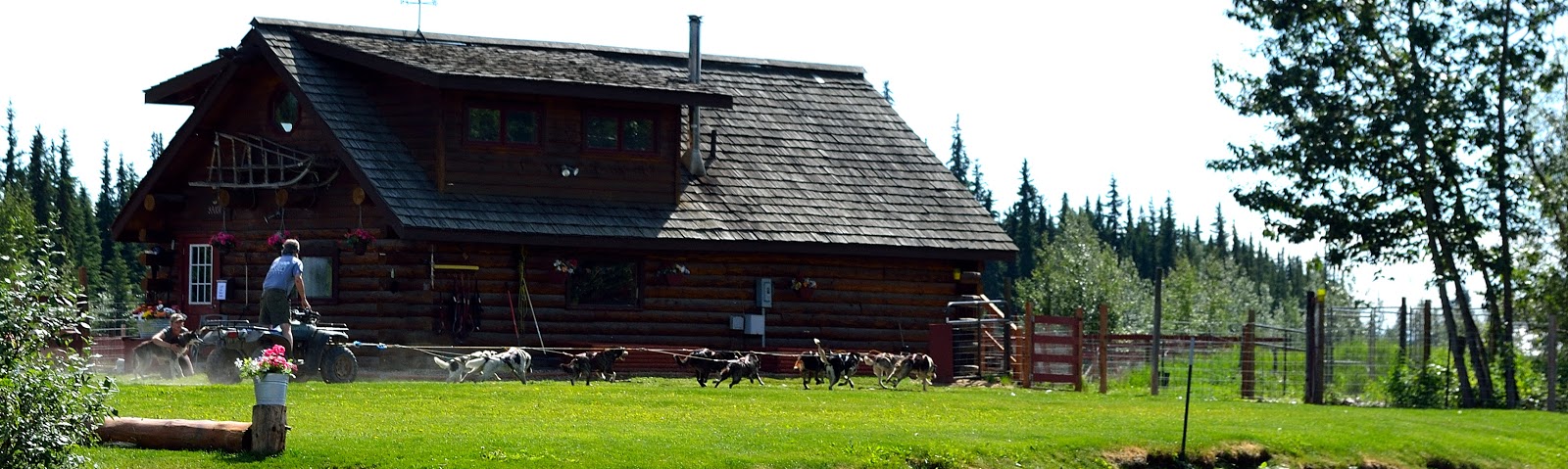
 We also watched a team of sled dogs pull a wheeler down the road. These animals are sooooooo powerful but most of all they love to work.

After a workout they are all individually betted and allowed to go into the water to cool off.
Continuing down the river we get to the point where we have to turn around. This is where the Chena River meets and flows into the much larger Tanana River.
On the way back we stop at a replica of an Interior Alaska Native Village and fish camp. We stop for an hour giving us enough time to walk around and see things.

Trapper's Cabin
On the return trip back we pass the remains of a couple sternwheelers.
Our final pause on the trip back was at the home of 94 year old Mary Binkley. She was out there waving at us as we went by.
The boat cruise ended right at 5 o'clock and we were at home with the dogs shortly after that. What a fun packed day.

Monday, July 2, 2018

Day 35 - Rig Repair Day Fairbanks, AK

Today is the day and I'm hoping everything goes well. I was up early, hooked up, and ready to go by 7:15 just as planned. I didn't want to be late. We found Arctic RV with no problems. I walk up to the door and try it, still closed but I see a note on the door that someone had to cancel their 8 am appt because of a medical emergency. Hopefully I can slide into their spot if they can find out what is wrong.  Now we sit and wait until 8.
The doors open and I run in. I tell the really nice young girl my situation that I called on Saturday and was told to be here on Monday by 8 and she said okay lets figure out what is wrong with your fridge but first lets do some paperwork. I almost started crying. Paperwork done I had to drive around back and back the rig into one of the bays. I can do that. I backed in on my first try. Kevin, the owner and only tech in the place comes over and I explain what the fridge is doing. He tells me he thinks he knows what the problem is, leave the rig and call him at noon. I almost started crying again. So I unhook and leave our home behind in the hands of a stranger. 

So what do you do when you don't have a home to go to. Drive around and explore of course. Our first stop was Walmart. We had to pick up a couple of things. Susan ran in while I stayed in the truck with the dogs. When we pulled into the parking lot it was like driving into a campground. There had to be 50 RV's of all shapes and sizes camping. People had their slides and awnings out, jacks down, tables set up, lounge chairs in place, and some were doing exercises. It was like a big party. This pic only shows a few of the rigs we seen.
Our next stop was the oil pipeline viewing area. When we were driving to Fairbanks we had our first sighting of the pipeline but unfortunately it was pouring rain so we didn't stop. This is a much better day.

In 1968, oil was discovered in Prudhoe Bay on the North Slope between the Brooks Mountain Range and the Beaufort Sea. A group of oil companies decided that building a pipeline would be the best means to transport the crude oil to a navigable port where it could be shipped by tanker to the continental US. Alyeska Pipeline was established in 1970 to design, construct, operate, and maintain the pipeline.

So how do they build this pipeline. In permafrost areas where heat from the oil in the pipeline might cause the ground to thaw and consequently become unstable, the pipeline is insulated and elevated above ground by means of a unique support system. This system includes support pipes embedded in the ground that sometimes contain heat pipes to remove the heat allowing the ground to remain frozen. These self-contained passive refrigeration devices contain gases which transfer ground heat into the air when the air temperature is cooler than the ground. This heat transfer process "super chills" the ground, ensuring that unstable soils remain frozen year round to steadily support the pipeline. There are more than 124,000 heat pipes along the pipeline.

Above ground sections of the pipeline are built in a zigzag manor to allow for expansion and contraction of the pipe due to temperature changes. This zigzag configuration also allows for movement of the pipeline during an earthquake, with a greater allowance for both lateral and vertical movements at major fault lines.
In thaw-stable soils, the pipeline was buried in the conventional manner, below ground.
Pipeline Facts:

  • the total length is 800 miles runs from Prudhoe Bay to Valdez, Alaska
  • the diameter is 48"
  • it crosses 3 mountain ranges and more than 500 rivers and streams
  • the pipeline corridor includes more than 550 crossing areas for caribou, moose, and other wildlife
  • there are 44 buried road crossings along the 800 mile pipeline to accommodate vehicle traffic
  • the cost to build was $8 million in 1977, the largest privately funded construction project at the time
  • construction began March 27, 1975 and was completed May 31, 1977
  • oil first moved through the pipeline June 20, 1977
  • first tanker to carry crude oil from Valdez: ARCO Juneau, August 1, 1977
  • between 1979 and 2010 more than 16 billion barrels of oil were transported through the pipeline
  • in 1988, 2,000,000 barrels of oil per day travelled through the pipeline, at this flow rate it took 4.5 days to travel from Prudhoe Bay to Valdez

Devices called "pigs" improved the flow of oil through the Trans Alaska pipeline and monitored its condition. Pigs are launched and retrieved at pump stations and travel through the pipeline with the moving oil. Pigs are among the most important tools available for protecting the pipeline and detecting potential problems.

This pig scraped wax from the internal walls of the pipe when the pipeline first began operating. Once the system warmed up from the constant flow of hot North Slope oil, wax buildup ended.
Later the scraper pig was replaced by a lighter and softer polyurethane version. The new polyurethane pig smooths the flow of oil by reducing the turbulence, making it easier to pump. Where we are standing the oil is about 100 degrees F. The old scraper pig weighed 2600 lbs which is 1000 lbs more than the new pig.
So that was pretty amazing. The dogs were able to get out and run around which is always nice for them. We continued to drive the city scouting out potential things we might to see later.
Overlooking Downtown Fairbanks
It was getting close to lunch time and I was starved. We hit the local McDonalds and had lunch in the parking lot. We relaxed, took the dogs for another walk, then I couldn't wait any longer I had to call to check on the rig. They informed me it was done. Another Halleluiah!. We drove over, Kevin showed me what the problem was, I paid the bill, and then we went home to relax for the rest of the day.

Sunday, July 1, 2018

Day 34 - North Pole, AK

We had decided even before our fridge went down that not spending a night in Delta Junction was reasonable. However, we would make a pit stop there since it is the northern terminus of the Alaska Highway.

But first, we left Tok and of course it was still raining. I think we have been fairly lucky with the weather so far. If the sun was shining I would never have gotten to Fairbanks. The view of the mountains was breathtaking even with the low cloud cover and rain. Every once in a while the sun would peek through and shine on the mountain…amazing.
We reached Delta Junction and stopped at the visitors center. The town got its name from the river along which it is situated and from the junction of the Alaska Highway and the Richardson Highway. The town came into being like many others as a construction camp for the building of the Alaska Highway in 1942. As I said earlier Delta Junction is the northern terminus of the Alaska Highway. We started the Alaska Highway at Dawson Creek, BC and now we are here at the end in Delta Junction, Alaska. Many are confused thinking Fairbanks is Mile 1523 when in actuality Fairbanks is the northern end of the historic Richardson Highway.
We arrive at our destination, River View RV Park in Fairbanks, AK shortly before 2 pm. It was just over a 5 hour trip. When I was in Tok, I called an RV place and they told me to be at their RV repair shop by 8 am on Monday. Okay, I can do that but in the meantime it’s Sunday with lots of time to see things so what better place to go but the North Pole to see Santa.

After we got set up we drove to the North Pole which is 11 miles from our campsite. North Pole received its name in a bid to lure a toy factory to the area in the 1950’s. The toy manufacturer never materialized but North Pole is now a residential community that prides itself on attracting people to their town. And I don’t think they have to try hard. It’s something about Santa, The North Pole, and we can’t forget about the reindeers. Their town motto is “Where the spirit of Christmas lives year round”. We had a great time shopping, looking at reindeer, and eating fudge.
After we got home and called it a day the skies opened up and it poured for about an hour. Surprisingly enough it also started to hail. They were about pea size but it was enough to hurt when I had to run back out to close the windows in the truck. Ouch!